Living with Drug-Resistant Epilepsy: Advanced Surgical and Dietary Therapies
Defining Refractory Epilepsy
The primary treatment for epilepsy involves Anti-Seizure Medications (ASMs). For about 65% to 70% of patients, the first or second medication prescribed will successfully control their seizures. However, if a patient has tried two properly chosen and appropriately dosed ASMs without achieving seizure freedom, they are clinically diagnosed with Drug-Resistant (Refractory) Epilepsy.
Continuing to try a third, fourth, or fifth medication yields diminishing returns, with less than a 5% chance of achieving seizure freedom. At this critical juncture, we must pivot from purely pharmacological management to advanced interventional evaluations.
Phase 1: Comprehensive Epilepsy Evaluation
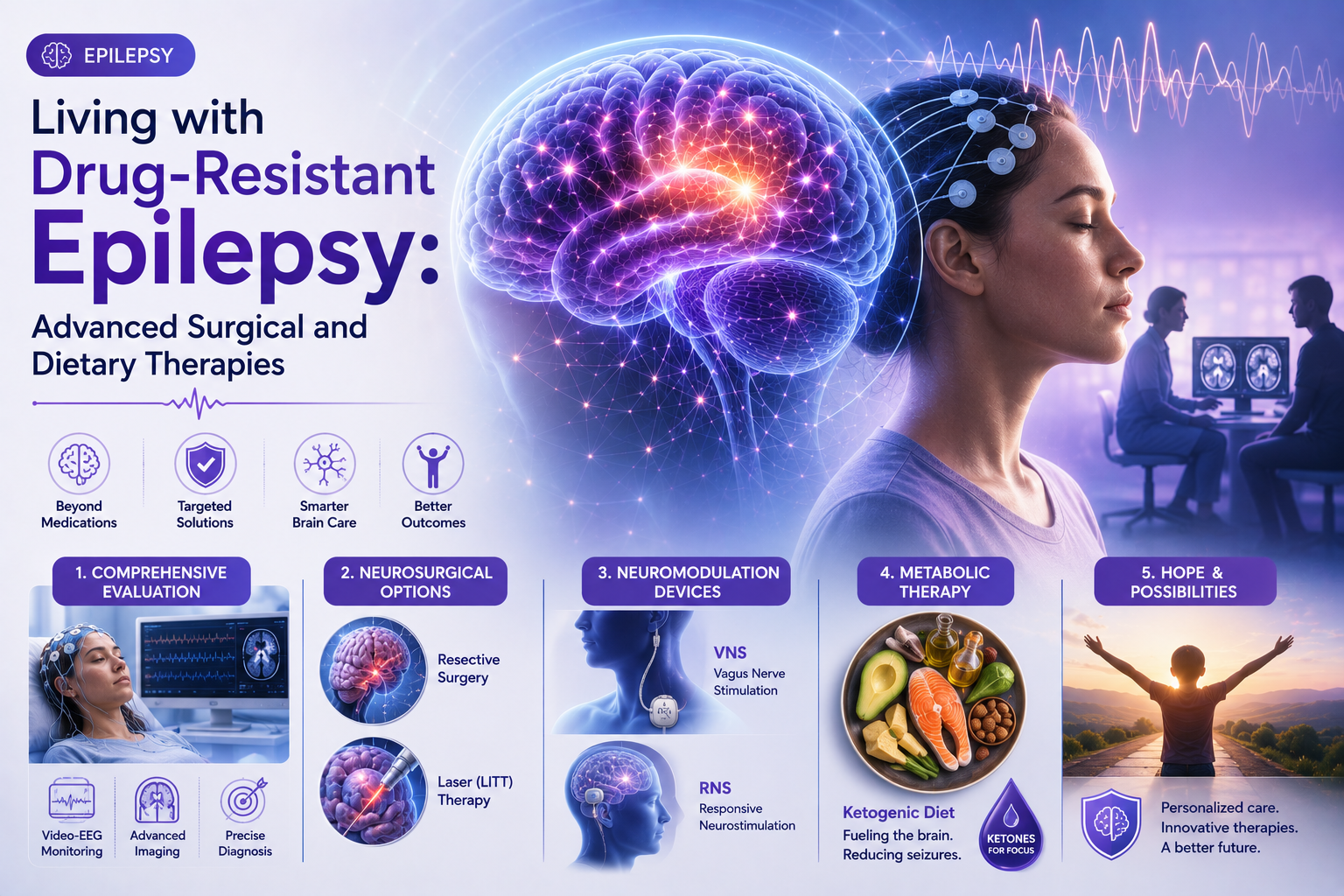
The first step in managing refractory epilepsy is admission to an Epilepsy Monitoring Unit (EMU). Here, the patient undergoes prolonged Video-EEG monitoring to capture typical seizures. This allows us to:
- Confirm the diagnosis (ruling out psychogenic non-epileptic seizures).
- Determine precisely where the seizures originate in the brain (the seizure focus).
This physiological data is combined with high-resolution structural MRI, PET scans (measuring brain metabolism), and sometimes MEG (magnetoencephalography) to map the brain's epileptic network.
Neurosurgical Options
If the tests pinpoint a single, safe-to-remove area of the brain causing the seizures, epilepsy surgery is often the most effective path to a cure.
- Resective Surgery: Removing the small portion of brain tissue where seizures begin (e.g., temporal lobectomy).
- Laser Interstitial Thermal Therapy (LITT): A minimally invasive technique using a laser probe to ablate the seizure focus under real-time MRI guidance, avoiding open brain surgery.
Neuromodulation Devices
If the seizure focus is in an area of the brain that controls critical functions (like speech or movement), or if there are multiple foci, surgery may not be possible. Instead, we use neuromodulation—devices that regulate brain electricity:
- Vagus Nerve Stimulation (VNS): A pacemaker-like device implanted in the chest that sends regular, mild electrical pulses to the brain via the vagus nerve in the neck, reducing seizure frequency and severity.
- Responsive Neurostimulation (RNS): A "smart" device implanted directly in the skull that continuously monitors brain waves, detects the onset of a seizure, and instantly delivers a counter-pulse to stop the seizure before clinical symptoms occur.
Metabolic Therapy: The Ketogenic Diet
Originally developed in the 1920s, the classic Ketogenic Diet—a strict high-fat, low-carbohydrate, adequate-protein diet—forces the brain to utilize ketones instead of glucose for energy. This fundamental metabolic shift alters neuronal excitability and is highly effective in managing refractory epilepsy, particularly in pediatric patients and specific genetic syndromes.
Expert Second Opinion
Facing a complex neurological diagnosis? Consult Dr. Ranjan Kumar for a thorough clinical review.
Book Now